
How to make a travel itinerary
Planning a travel itinerary can be overwhelming.
Hundreds of tabs open with “what to see in…”, “tickets to…”, “places to eat in…”. And, of course, Google Maps on the side to see how long it takes you to get from one place to another. It’s just too much stuff!
We know it’s time consuming, so as travel planning experts we show you how to make a step-by-step, leak-free travel itinerary.
With a good travel itinerary, everything becomes easier. Having a plan doesn’t mean that every minute of the trip is timed, it means being able to make the most of your time. This translates into making sure you visit what you are really interested in and avoid wasting time on unnecessary trips.
What is a travel itinerary
A travel itinerary, or trip plan, goes beyond a simple list of places. Think of it as the skeleton of your adventure. A strategic plan that helps you maximize every minute, avoid unforeseen events and make sure you don’t miss anything essential.
What information should your travel itinerary include?
- Date: one route per day.
- Places to visit
- Schedules: for visits, excursions, entrance fees, etc.
- Location: where the place is located.
- Time: time spent in each place.
- Travel: time spent between one place and another.
- Tickets: link or PDF of your reservations.
- Additional notes: with relevant information.
Why a travel itinerary is important
The best part of a trip is what you experience, but without a good itinerary, you can feel lost and miss unique moments. Planning well will ensure that you enjoy every moment of your adventure:
- Optimize your time: you will avoid wasting hours at your destination looking for what to do, what to see or how to get to a place.
- Avoid unforeseen events: like arriving at a museum and discovering that it is closed, or that you needed to buy tickets in advance.
- Reduce stress: having a travel plan gives you peace of mind. It allows you to relax while you enjoy yourself, since you won’t have to spend time on your trip researching what you can see.
- Make your schedule more flexible: although it sounds contradictory, an itinerary gives you room to improvise. When you have reflected in your travel plan what is essential to visit, you know what spaces you have available to make adjustments on the fly.
For example:
If you visit a city like Rome, a good itinerary would not only indicate that you are going to the Colosseum. A well-organized itinerary would include details such as:
- At what time you have your guided tour, or what is your entrance time.
- How to get there from your point of origin.
- The link or PDF to your tickets.
- How long you will be there.
- Where you will go next.
- Additional notes, such as that you need to show your ID at the entrance, for example.
Is a travel itinerary required for all trips?
The answer depends on the type of traveler you are and your travel destination. Surely, if you are traveling to a remote beach to relax, a travel itinerary will not be necessary. However, for any destination full of historical sites, museums, activities, restaurants, etc., an itinerary is essential so you don’t feel lost and can make the most of your time.
Think that a travel itinerary is not a limitation, but a tool to take advantage of your trip to 100%. Undoubtedly, the best way to turn a trip into a great trip, that unforgettable experience that, before it ends, you are already thinking about when to repeat.
How to make a travel itinerary
Let’s be honest, making a good travel itinerary is time consuming. But it doesn’t have to be complicated.
What should you consider when planning your next trip?
- Make a list of places of interest
- Define your priorities
- Estimate the time needed for each place
- Group your places of interest by zones
- Check your travel time
- Adapt your route to your travel pace
- Book your tickets in advance
- Be flexible
1. Make a list of places of interest
The first step is to find out what there is to see in the destination that awaits you. The most common options are:
- Ask friends or relatives who have visited. They usually know your tastes and offer a more objective view of the trip, they will know how to give you good advice.
- If you do not know anyone who has been, go to travel blogs, such as the one you are on, Cocotrip.
Whichever way you choose, the important thing is to finish this step with a list of interesting places that await you at your destination.
2. Define your priorities
From the list of places that you extracted, there are surely some that call your attention more or less. It’s time to prioritize! We recommend you to do this categorization:
- Must-sees: places you really want to see. The typical “must-see in…”, or whatever you are really looking forward to seeing.
- Optional: places that you wouldn’t mind visiting if your planning allows it, but that are not essential.
- Extras: places that are quick stops that you can consider including if they are within your travel route.
Think that, usually, a destination has more places to see than we could actually enjoy in the duration of our trip. This step is key to organizing YOUR own ideal travel itinerary, which may be very different from that of anyone else.
3. Estimate the time needed for each place
One of the most common mistakes when traveling is to underestimate the time you need to see each place. To get this information:
- When it is an organized tour or visit: they usually tell you how long it will take.
- For places you see at your own pace: you might ask yourself, how long can it take to see the Colosseum? It is very difficult to answer that question to yourself when you don’t know the place. The good thing is that there are many before you who have already visited it. If you put that question directly into Google, it will give you an estimate that you can take as a reference. After that, the interesting thing is to adapt it to your way of traveling.
This point of itinerary planning is important to be able to adjust your travel plan realistically, and not leave any of your must-sees behind!
4. Group your places of interest by zones
A good way to optimize time is to group those places that are close to each other to visit them on the same day. This will avoid unnecessary trips and will make your tour smoother.
To do this you can use Google Maps:
- Check where each of the places you want to see are located and mark them on a map.
- You will have to organize as many groups of sights as days you are going to go.
- Let’s say you are going to Rome for 3 days. You will have to organize three groups of sights according to where each one is located.
5. Check your travel time
As well as estimating the time you will spend in each place, checking how long it will take you to get from point A to point B of your route is essential. This will allow you to make sure that you are not going to be late anywhere, an aspect that is especially relevant when you are in a city you do not know.
Once you have grouped your places of interest by zones, go day by day checking how long it takes you to go to each of the points. Consider whether you are going to walk or need some kind of transportation. Leave some margin of displacement in case some unforeseen event arises with the transport or you would like to take a coffee on the way.
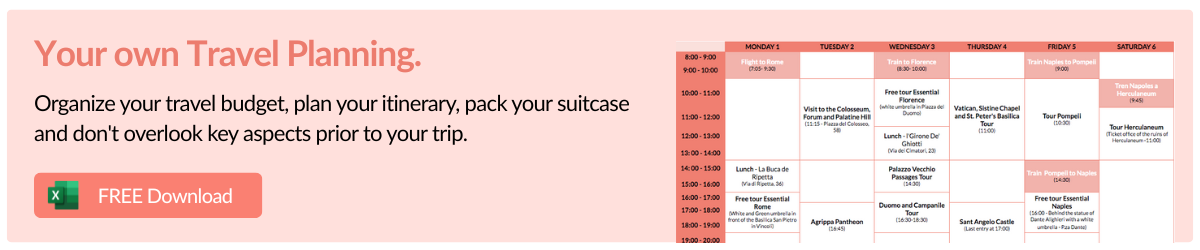
To have it at hand you can create a travel itinerary in Excel.
6. Adapt your route to your travel pace
To have it at hand Once you have your places of interest grouped and you have measured the distance between the points, it’s time to do the math. How much time do you spend on your route of day 1 between the time in each place and the travel between the sites?
To adjust it to your reality you should ask yourself what kind of traveler you are:
- I am one of those who leave early in the morning and do not return to the hotel until the evening.
- I am one of those who leave early but go back to the hotel to rest and then continue the route.
- I’m not an early riser, but I don’t go back to the hotel until the evening.
- I am not an early riser and I go back to the hotel to rest before continuing the route.
You should keep in mind that your travel pace conditions the time you have available to visit the places of interest on your route.
7. Book your tickets in advance
Once you are clear about the route you want to take, you should check in advance which tickets you need to buy. Keep in mind that for many popular destinations you will have to buy tickets before arriving at your destination.
It is becoming more and more common that, when booking tickets, you have to choose a visiting hour. Try to adapt your entrance times to the route you have designed. Keep in mind that if you have not booked your tickets well in advance, it is likely that you will have to make changes to your route to adapt it to the visiting hours.
8. Be flexible
An itinerary is an excellent travel guide that allows you to make the most of the time available and make sure you see what interests you most. But remember to leave room for improvisation. It is likely that while at your destination you will discover something that you did not see during your research and that you feel like doing.
Organize your itinerary well but leave some free spaces. Think that if you don’t see anything at your destination that you are interested in exploring, you can always use your list of extra places of interest, have conversations with local people or take advantage of a leisurely stroll through the city.
Travel itinerary example to Rome
So that you can see it first hand, based on the step-by-step we show you to create a travel itinerary, let’s make one to Rome together.
1. Make a list of places of interest
Before we started creating our route plan, we gathered information from the Cocotrip blog and other travel blogs. In addition, we asked friends and family about their recommendations and browsed through the occasional travel guide.
This left us with an initial list of 17 places of interest:
- Colosseum
- Roman Forum
- Palatino
- Trevi Fountain
- Spanish Steps
- Vatican Museums
- St. Peter’s Basilica
- Piazza Navona
- Pantheon
- Campo de’ Fiori
- Trastevere
- Galleria Borghese
- Castel Sant’Angelo
- Baths of Caracalla
- Aventine and the famous “keyhole”
- Catacombs of St. Sebastian
- Villa Doria Pamphili Park
2. Priority setting
From this initial list, we make a categorization to define our level of interest in each place:
- Must-see: Colosseum, Roman Forum, Palatino, Vatican Museums, St. Peter’s Basilica, Trevi Fountain, Pantheon, Piazza Navona, Trastevere.
- Optional: Campo dei Fiori, Castel Sant’Angelo, Galleria Borghese.
- Extras: Mouth of Truth, Villa Doria Pamphili Park, Baths of Caracalla.
This categorization ensures that in the days available we will not miss the most important things, leaving room to explore more if we have additional time.
3. We estimate the time needed for each location
We search on Google and ask friends and family to find out the estimated time we will be able to spend at each point.
- Colosseum: 2 hours with full tour and photos.
- Roman Forum and Palatine Hill: 2 hours to explore the ruins.
- Trevi Fountain: 20-30 minutes to enjoy the square and coin toss.
- Vatican Museums: 3 hours minimum.
- St. Peter’s Basilica and Square: 2 hours to visit the basilica and climb the dome.
- Castel Sant’Angelo: 1 hour and a half (optional).
- Pantheon: 1 hour.
- Piazza Navona: 30 minutes.
- Campo dei Fiori: 1 hour (optional).
- Galleria Borghese: 2 hours (optional).
- Trastevere: 2-3 hours in the afternoon for strolling and dinner.
4. We group the sites by zones
We organize the places close to each other to visit each day more efficiently:
- Day 1: Colosseum, Roman Forum, Palatino, Trevi Fountain, Pantheon, Piazza Navona, Trastevere.
- Day 2: Vatican Museums, St. Peter’s Basilica, Castel Sant’Angelo, Campo dei Fiori.
This not only reduces travel, but also allows you to enjoy more time in each place.
5. We check the travel time
To avoid unforeseen events, we calculate the transfer times between each point:
- Day 1:
- From the Colosseum to the Roman Forum: 5 minutes on foot.
- From the Roman Forum to the Trevi Fountain: 15 minutes on foot.
- From the Trevi Fountain to the Pantheon: 10 minutes on foot.
- From the Pantheon to Piazza Navona: 5 minutes on foot.
- From Piazza Navona to Trastevere: 20 minutes by bus.
- Day 2:
- From the Vatican Museums to St. Peter’s Basilica: 10 minutes on foot.
- From the Basilica to Castel Sant’Angelo: 15 minutes walk.
- From Castel Sant’Angelo to Campo dei Fiori: 15 minutes on foot.
6. We adapt the itinerary to our travel pace.
In this travel itinerary example, we only have two days to see Rome. We assume that we are the type to leave the hotel early to make the most of the day. Therefore:
- We dedicate the mornings to visiting the main sites and doing the most tiring part of the route.
- We leave the afternoons for more relaxed activities, leaving time to include impromptu activities.
- In addition, we plan extra time for rest and meals in restaurants along our route.
7. We book tickets in advance
To ensure access, and that we can meet our itinerary:
- We reserve all activities that require a ticket.
- We choose schedules that allow us to comply with our route.
- We leave margin for unforeseen events, to avoid losing the reservation of the activities.
As you have seen in this article, knowing how to make a travel itinerary is a must. A well-planned travel itinerary turns any trip into a TRIP.